


Naskapi Nation of Kawawachikamach Flag

The Flag of the Naskapi Nation of Kawawachikamach was designed by the late Stephen Mameamskum. He drew the flag using colored pencils and pens, as part of a contest held by Sandy Robinson at Jimmy Sandy Memorial School.

Photo provided by Bianca-Eliza Sandy, his daughter.
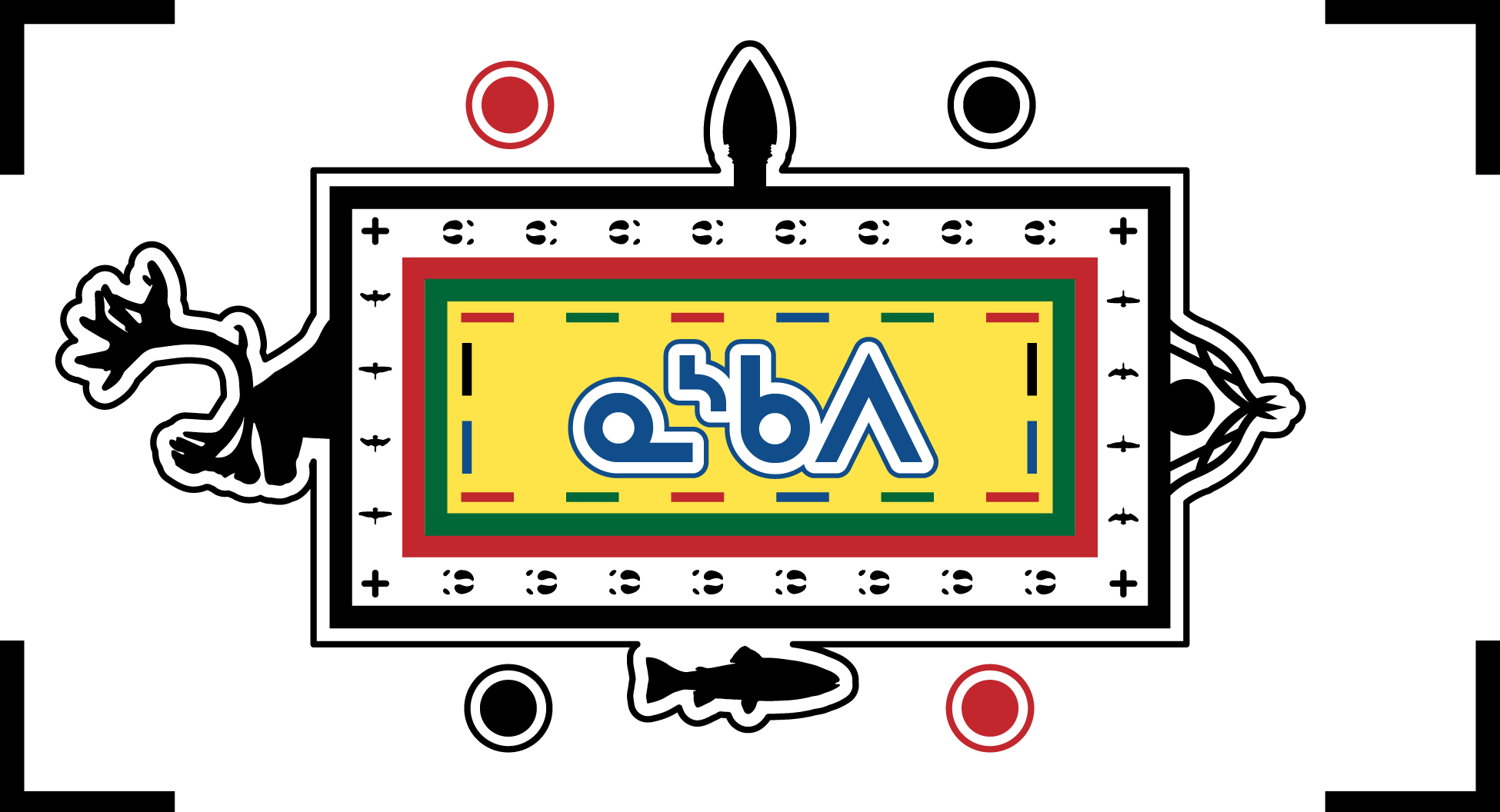
Each portion of the flag has a specific meaning for the Naskapi people.
Interpretation
- Wigwam: Located in the East, because that’s where the Naskapi originally came from.
- Spear: Located in the North, because that’s where they lived with the Inuit before moving to Schefferville. The Inuit were spear-throwers.
- Caribou: Located in the West because that’s where the Caribou migrate to in the fall. This is a time of celebration for the Naskapi.
- Fish: Located in the South because sometimes the Naskapi import, through other tribes, special fish from the North Shore of the St. Lawrence.
- Black Outline: This means that the Naskapi are a close-knit people, isolated from the outside world.
- Caribou Tracks: The tracks move from East to West in a continuous cycle. The Caribou is an important cultural symbol for the Naskapi.
- Canadian Geese: The Geese fly North and South, again a time of celebration for the Naskapi.
- Crosses: The Crosses in each corner represent the Religious aspect of the Naskapi.
- Circles: Represent the Suns and Moons of each season.
- Red Boundary: The colour Red symbolises that the Naskapi are Natives, and thus Red Blood.
- Green Boundary: The colour green indicates that the Naskapi live with Nature. It is a sign of earth life.
- Colours: The Colours represent the taste of the design patterns of the Naskapi people.
- Insignia: The word Naskapi in syllabics: ᓇᔅᑲᐱ.
Original Drawing


Files
Naskapi Nation of Kawawachikamach Adobe Illustrator File
Naskapi Nation of Kawawachikamach EPS File
Naskapi Nation of Kawawachikamach SVG File
Variations
There are a few variations that may be displayed of the Naskapi Nation of Kawawachikamach Flag, and they are included below.


Purchasing a Flag
Flags may be purchased for $110 CAD.
To purchase a flag, send an email with the number of flags you wish to purchase and the shipping address.
Annual Reports
Elections
Archeaology
Protecting the Cambrien and Nachicapau Lakes Areas and recommendations for future research, land protection, and synthesis of findings
This report reviews oral histories, past archaeological work, historical documents, and geographic data to identify locations within the Cambrian and Nachicapau Lakes areas most likely to contain archaeological sites. It produced the first mapping of “high potential” zones and laid the foundation for planning the 2021 and 2022 field surveys.
This report reviews oral histories, past archaeological work, historical documents, and geographic data to identify locations within the Cambrian and Nachicapau Lakes areas most likely to contain archaeological sites. It produced the first mapping of “high potential” zones and laid the foundation for planning the 2021 and 2022 field surveys.
This report reviews oral histories, past archaeological work, historical documents, and geographic data to identify locations within the Cambrian and Nachicapau Lakes areas most likely to contain archaeological sites. It produced the first mapping of “high potential” zones and laid the foundation for planning the 2021 and 2022 field surveys.
This document details the 2023 follow-up work, including mapping, artifact documentation, and revisits to key sites. It adds significant data about Fort McKenzie–period sites, Precontact toolmaking areas, and post-fire exposures at Piyaaskwaastikw. It includes site maps, artifact photos, and descriptions showing how the field team refined site interpretations.
This is a full 303-page report on the 2024 fieldwork. It includes new excavations, radiocarbon dating, scientific sampling, community site visits, environmental studies, and major discoveries at Kaa Upiyaakaaw 1 and 2, Shale Falls, Nachicapau Lake, and Mistisipu Nipiy. It also documents six new sites, community visits with elders, a
Environment
2025 Naskapi Caribou Hunt Guidelines
The presentation outlines how the Naskapi Nation plans to manage the 2025–2026 caribou hunt by explaining territorial hunting rights, proposing a step-by-step community-based decision-making process grounded in herd science and traditional values, and beginning discussion on sustainable harvest levels and future Naskapi caribou conservation guidelines
2025 Update on the demography of the George and Leaf River migratory caribou herds
The presentation reports that both the George River and Leaf River migratory caribou herds remain at low and precarious population levels, with the George River herd showing modest recent growth. However, still far below historical numbers, and the Leaf River herd is shifting from stability to a clear declining trend driven by low calf recruitment, habitat disturbance, and ongoing pressures, requiring continued conservation and harvest restrictions.
2016 Assessment of Climate Change Impacts on the Caribou, the Land, and the Naskapi Nation (Final Report)
This is the full 100+ page assessment detailing climate impacts, community observations, caribou ecology, food security, health, and adaptation strategies. It’s the flagship document.
Naskapi Climate Change and Wildlife Food Security – Adaptation Canada Presentation
This is a condensed, presentation-friendly version of the project, useful for conferences, school use, or community training.
Community Workshop Report – February 2012 (Caribou & Climate Change Project)
This is the plain-language workshop recap that documents observations from elders, hunters, and trappers. It’s perfect for residents who need a readable summary rather than the whole report.
A Long Time Ago in the Future: Caribou and the People of Ungava (2017–2117)
This is a long-term, Indigenous-led plan for caring for the caribou of the Ungava Peninsula. It is signed by all major Indigenous Nations in the region: Inuit (Nunavik, Nunatsiavut), Innu, Naskapi, Cree, and NunatuKavut.
Big Game in Québec; Harvest Data from May 1, 2007 to April 30, 2008; Lucie Gignac; August 2009
This study reports how many large game animals such as moose, caribou, deer, and bears were harvested in Québec during the 2007–2008 hunting year, using mandatory hunter reports to track trends by species, region, sex, and age to support wildlife management decisions
Relationships Between Runoff Generation and Active Layer Development Near Schefferville, Quebec (1976–1979) — Richard K. Wright
From 1976 to 1979 near Schefferville, this study found that how water moves and freezes in the ground plays a big role in how deep the ground thaws and how runoff forms, not just how heat moves through the soil.
Governance
By-law No. 561
This informs that the specified by-law related to the Naskapi Nation elections has undergone the necessary approval steps and has now been officially approved and is in effect.
Northeastern Québec Agreement
The Northeastern Quebec Agreement (NEQA) settles the land claims of the Naskapi Indian band, exchanging their claims, rights and territorial interests for other rights and benefits.
Naskapi and the Cree-Naskapi Commission Act
Cree-Naskapi (of Quebec) Act (S.C. 1984, c. 18). An Act respecting certain provisions of the James Bay and Northern Quebec Agreement and the Northeastern Quebec Agreement relating principally to Cree and Naskapi local government and to the land regime governing Category IA and Category IA-N land.
Naskapi-Québec Partnership Agreement
The Naskapi-Quebec Partnership Agreement was signed in Kawawachikamach on October 19, 2009, by the Nation, Quebec, and the Naskapi Development Corporation. The Agreement addresses a number of community and economic development matters. The implementation of this Agreement will be an important process for the future growth and development of the community.
Memorandum of Understanding – Cree, Inuit and Naskapi Forum
A renewed declaration of collaboration and cooperation, expressed in unity, vision, capacity and creativity, by the Cree, Inuit and Naskapi Nations, the Northern Quebec’s natural caretakers and treaties’ partners, grounded on their forefathers/mothers’ sacrifices, yet on which rests the hopes and aspirations of their respective future generations.
Joint Resolution between the Naskapi Nation and the Naskapi Development Corporation
The Joint Resolution between the Council of the Naskapi Nation of Kawawachikamach and the Board of Directors of the Naskapi Development Corporation outlines a renewed cooperative relationship built on open communication, shared planning, and a unified commitment to the prosperity of the Naskapi people. Signed on October 24, 2025, this document establishes clearer ways for both leadership bodies to work together, strengthen economic and cultural initiatives, support long-term funding efforts, and explore how this renewed partnership may be reflected in the Nation’s future Constitution.